
Construction
Construction Debris Disposal on the South Plains
A Lubbock roll-off operator's guide to running construction debris on a South Plains jobsite: separating streams, weight limits on caliche and concrete, wind, playa stormwater, and phasing containers by trade.
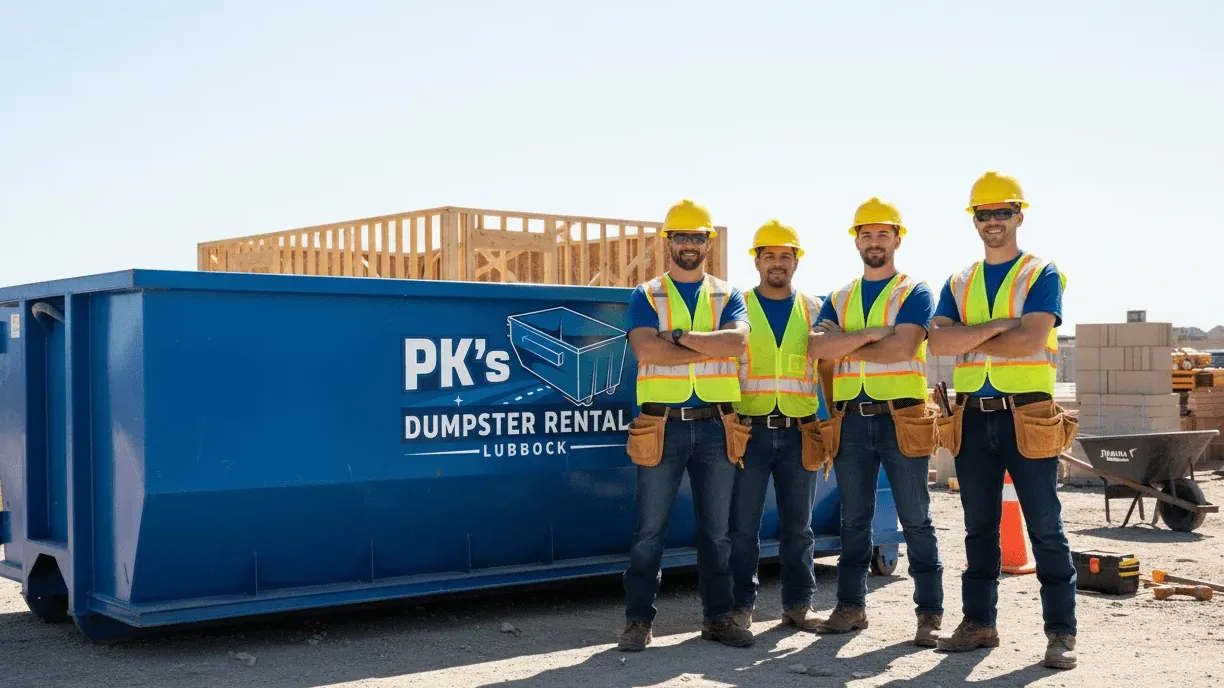
A jobsite that handles its own debris well is invisible. The container shows up before the trade that fills it, it leaves before it is heaped, and nothing from that box ends up on a fence two streets over.
Most of the money builders lose on debris is not lost at the landfill. It is lost in dry runs, rejected loads, a crew waiting on an empty box, and two hours chasing housewrap across a caliche lot because somebody built a load wrong on a 40 mph afternoon. Here is how to run debris on a South Plains jobsite so it stays boring.
C&D and municipal solid waste are two different streams
Construction and demolition debris is its own waste stream: lumber, sheathing, drywall, roofing, siding, insulation, trim, flooring, tile, concrete, brick, block, fixtures and fencing. Municipal solid waste is the household and commercial stream — food waste, packaging, general trash. The contents of a house rather than the house itself.
The distinction determines where a load goes and how it is rated. C&D-only material routes to facilities set up for it, and clean single-material loads route to processors instead of a landfill. The moment a container mixes streams — the framing crew's lunch trash, a bagged garage cleanout on the drywall — it becomes a mixed load and gets rated as general waste no matter how good the bottom two thirds looked. Our guide to what can go in a dumpster in Lubbock County has the full material list.
The practical version: keep a construction debris container for the building and give the crew a small can for cups, wrappers and food. It costs almost nothing and keeps the big box clean.
Separating streams pays. Mixed loads recover nothing.
- Clean concrete, brick, block and caliche gets crushed for fill and road base. Clean means clean — no wood, no drywall, no trash. Give it a dedicated concrete and heavy debris container.
- Clean wood — untreated framing offcuts, pallets, dimensional lumber — gets ground. Painted, treated or laminated material contaminates the load.
- Metal is scrap with real value: duct, conduit, copper, flashing, rebar, studs and the metal roofing common on ag buildings.
- Cardboard from appliance, cabinet, window and door packaging bales if it is kept dry and flat. On a big house that is real volume you are not paying to haul.
- Brush and clean green waste. Texas has no statewide yard-waste landfill ban, but clean brush gets ground for mulch instead of buried, and the City of Lubbock runs brush collection and a citizens collection station. Burning it usually is not an option — burn bans are routine here.
Mixed loads recover none of that. Crushed concrete with drywall in it is not fill any more. Our notes on recycling and disposal in Lubbock County cover where each stream ends up.
Weight is the constraint on almost every load out here
This is what catches builders new to the South Plains. Volume is not usually what fills a container here. Weight is.
Caliche, concrete, brick, block, tile, mortar and dirt run roughly 2,400 to 2,800 pounds per cubic yard. Ten cubic yards of broken slab is near twelve to fourteen tons. The same volume in framing scrap is a fraction of that.
So heavy material goes in a small box and gets swapped. A 10 yard roll-off or a 15 yard roll-off is the right container for concrete, caliche, brick, tile and masonry, and the right plan is a series of swaps rather than one enormous box. A 40 yard container loaded with masonry is not something we can safely or legally pull, and a truck that hooks an over-weight box and sets it back down costs everybody a day. The 30 and 40 are for bulk — framing scrap, insulation, cardboard, siding. Mixed C&D from a house under construction usually lands in a 20, with the heavy phases pulled into their own small box.
The wind will empty your container if you let it
Lubbock is one of the windiest cities in the country and an open jobsite has nothing to slow it down. Housewrap offcuts, batt insulation, foam board, cardboard, shingle wrappers and vinyl siding offcuts do not stay in a container on a windy afternoon. They leave the box, they leave the lot, and then they are your problem, because the neighbourhood knows which site they came from.
- Load heavy on top of light. Sheathing scrap or broken block across a load of insulation holds it down better than anything else.
- Keep everything below the rails. A heaped load cannot be covered, cannot be legally hauled, and is a wind sail.
- Tarp or net the box at quitting time during framing, insulation and roofing.
- Site the container in the wind shadow — building, fence, or the material stack early in the build.
- Bag the light stuff. Loose insulation and foam fragments in contractor bags stay put.
There is a longer version in our piece on securing a dumpster load against wind and dust. Haboobs roll through in spring, and a load built loose in March redistributes itself.
Stormwater, playas and the aquifer under your feet
Construction site runoff is a real regulatory issue here, not a formality. The Llano Estacado is dotted with playa lakes — shallow ephemeral wetlands that are the main recharge for the Ogallala Aquifer. Runoff does not disappear downstream. It collects in a playa and works into the water everybody out here pumps.
Keep spoil piles, caliche stockpiles and concrete washout well away from playas and the drainage that feeds them. Washout goes in a contained area, not the low corner of the lot. Sediment control, stabilised entrances and inlet protection are standard practice here for a reason. Stormwater permitting runs through the Texas Commission on Environmental Quality and the city has its own programme — check current thresholds with the City of Lubbock before you break ground, because requirements change.
Phase the containers by trade
One box for the whole build is the most common mistake I see. Every stream ends up mixed, the heavy phases blow the weight, the light phases waste volume, and there is always a stretch where a crew is stacking material on the ground.
Phase it instead. Order the container that fits the trade working, and call for the swap before the box is heaped. We run same-day and next-day delivery with next-day swap-outs, but a call Thursday afternoon for a Friday swap beats a call at 7am with the drywall crew on site.
| Project phase | Dominant debris | Container size | What catches people out |
|---|---|---|---|
| Demo & site prep | Caliche, concrete, slab, brick, dirt | 10 or 15 yard, swapped | Weight, not volume. A box that looks half empty is at its limit. Never a 40. |
| Foundation & masonry | Broken block, mortar, brick, form lumber | 10 or 15 yard | Form lumber in clean masonry kills the crushing route for the whole load. |
| Framing & sheathing | Lumber offcuts, sheathing scrap, banding, housewrap | 20 or 30 yard | Housewrap and wrapper scrap fly. Cap the load daily, keep it below the rails. |
| Roofing | Shingles, felt, wrappers, old decking, flashing | 15 or 20 yard | Shingles are dense — roughly 250 lb per square. Wrappers are the worst wind offender on site. |
| MEP rough-in | Conduit, duct, pipe offcuts, copper, cardboard | 10 or 20 yard | Most of it is scrap metal with value. Pull it before it goes in the box. |
| Insulation & drywall | Batts, foam board, drywall scrap, cardboard | 30 or 40 yard | Pure volume and nearly all of it airborne. Tarp it every night without exception. |
| Finish & trim | Trim, flooring scrap, tile, cabinet cartons, packaging | 20 yard | Tile and stone spike the weight in a box everyone treats as light. |
| Punch & final clean | Packaging, protective film, jobsite trash | 10 or 20 yard | Ordered too late. This is the box that holds up a final walk. |
New construction on the south and west edge
Most new residential volume here is on the south and west sides — the Milwaukee Avenue and Frankford Avenue corridors, the additions south of 98th, and the stretches past the Loop toward Woodrow. Those lots share a profile: wide open, no mature trees, wind straight across, often a caliche pad before paving goes in. Wind exposure is at its worst there, because nothing is standing to break it until the neighbouring house goes up. Placement matters too: protection boards go down as standard on a poured drive, but a fresh caliche pad after rain will rut under a loaded truck, and that rut is yours to fix. More in our piece on protecting a driveway during delivery.
Agricultural and county work
Equipment sheds, shops and outbuildings in the county are steady work, especially around gin season. Metal teardowns and storm-damaged outbuildings fit a demolition debris container, and the metal is worth separating. Three things to sort before a truck comes down a caliche lane:
- Wet caliche ruts. A caliche county road or lane that has taken rain will not hold a loaded roll-off truck. Tell us if it has rained and we will look at timing or a firmer set spot.
- Flag the septic and the well. Rural properties have both and neither is marked. A lateral field will not survive a loaded truck crossing it.
- Overhead lines and gate width. The truck needs clearance to raise the hoist, and low service drops to a shop are a common surprise.
Before any digging, in town or out, call Texas 811 for locates. It is free, it is required, and it takes a couple of days, so it belongs on the schedule.
Renovation on pre-1980 stock: asbestos and lead
Tech Terrace, Overton and central Lubbock are full of 1930s through 1950s housing, and that stock changes how a job starts. Pre-1980 buildings routinely contain asbestos in resilient floor tile and the black mastic under it, in popcorn and textured ceilings, in pipe and duct wrap, in roofing felt, and in older siding and joint compound.
In Texas, asbestos is regulated by the Texas Department of State Health Services under the Texas Asbestos Health Protection Rules. Demolition generally triggers a NESHAP inspection and notification — a survey by a licensed inspector before the work, not after somebody has put a saw through a ceiling. If material is found it comes out under a licensed abatement contractor. We cannot take asbestos-containing material in any container, in any quantity. Pre-1978 houses also carry lead paint, and the EPA's RRP rule applies to firms disturbing painted surfaces. Rules and thresholds change, so confirm current requirements with DSHS and the EPA before you scope a pre-1980 renovation.
Hail season, and dry runs
Hail season runs roughly March through June and Lubbock sits in a serious corridor. After a big cell the whole roofing trade books at once, adjusters stack up, and lead times stretch for weeks. If roofing is in your schedule in that window, get the container on the calendar early — the roofing tear-off size guide covers sizing, which is its own problem because shingles are dense.
A dry run is a truck that goes out and comes back with nothing done. They happen for the same handful of reasons: a vehicle or material stack in the set spot, a load heaped above the rails, a locked gate, overhead lines in the way of the hoist, an over-weight box, or an approach turned to mud. Fix all six with one habit — walk the placement the day before the truck comes, and keep the set spot clear and coned. We would rather reschedule than send a truck to look at a locked gate.
If you are running a build, a remodel or a county job on the South Plains and you want the debris side to stay boring, we will help you phase it before the first box lands. PK's Dumpster Rental Lubbock has run roll-offs here since 2015 — licensed and insured, flat-rate, protection boards standard, same-day and next-day delivery with next-day swap-outs. Call Paul and the crew at (806) 758-7942 and tell us what phase you are in.
Questions this guide did not answer? Call (806) 758-7942. We would rather spend two minutes on the phone than have you order the wrong container.