
Roofing
Roofing Tear-Off Dumpster Size Guide for Lubbock: Squares, Layers and Weight
A roof tear-off fills a container by weight long before volume. How to size one in Lubbock by squares and layers, why a 40 is the wrong box, and how to work hail season.
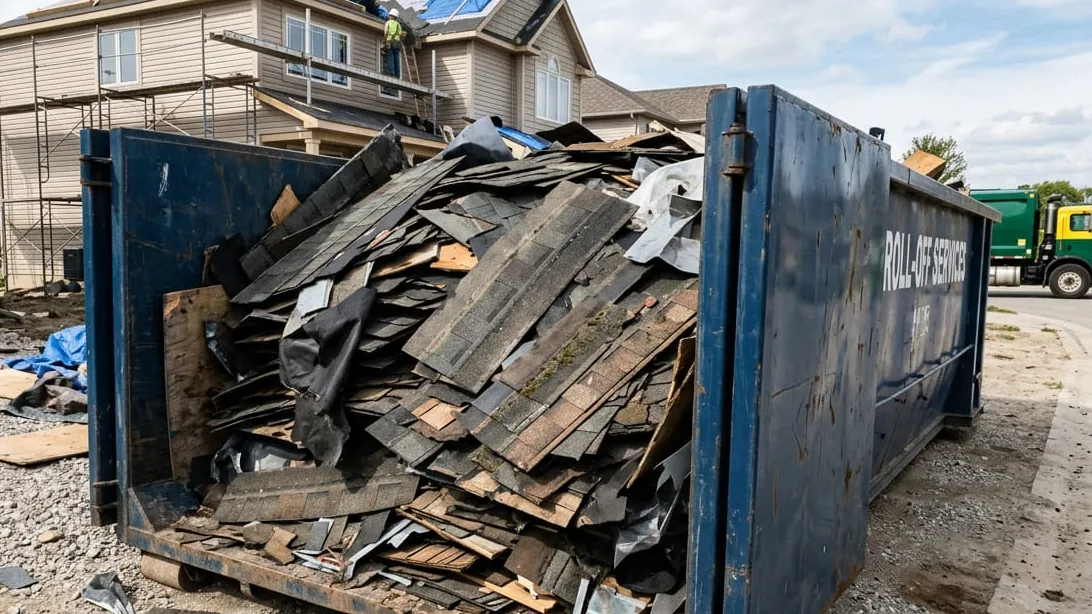
More roll-offs go out of our yard for roofing than for any other single job, and it is not close. Hail runs this town. A cell comes through in May and for the next four months half the driveways between the Loop and Frankford have a container on them. So I get the sizing question constantly, and almost everybody asks it the wrong way.
They ask how big the roof is in square feet, or they describe the house, or they tell me how big the pile looks like it will be. None of that gets you to the right box, because a tear-off is the one residential job where the container fills by weight long before volume.
Roofing is a weight problem, not a space problem
Understand that one thing and the rest is detail. Shingle is asphalt and mineral granules and it stacks flat with almost no air in it. A pile in the bottom of a 30 yard container can hit the truck's legal limit while the box is still two thirds empty above it. Roll-off trucks drive on public roads and axle weights are real: if the box is over it does not move, and somebody ends up in your driveway with a pitchfork pulling shingle back out while the job stops.
So the question is not how much room you need. It is how much weight you are creating and what is the smallest box that holds it safely. That usually points at a smaller container than the homeowner expected. Our general guide to sizing a dumpster in Lubbock covers the volume-driven jobs; roofing is the weight exception.
The only two numbers that matter: squares and layers
A square is 100 square feet of roof surface. Not floor area — roof surface, including pitch and overhangs, every plane on the house. A typical Lubbock ranch runs 18 to 24 squares; a two-storey on the south side with dormers and hips can go past 35. Your roofer already knows the number because he measured it to write the bid, so ask for it before you call anybody about a container. Without a bid, the shortcut is heated square footage divided by 100 plus 15 to 25 percent for pitch and overhang.
The second number is layers. A lot of Lubbock stock was shingled over rather than torn off, particularly the 1950s and 1960s neighbourhoods. Two layers is common, and three shows up more often than you would think in central Lubbock. Layers multiply, they do not add a little: two roughly doubles your weight, three roughly triples it. Size for one layer, then have the crew open the deck and find three, and you have lost a day.
Roughly what a square weighs coming off
- Three-tab asphalt shingle: around 200 to 250 pounds per square. The light end, and what is on most older Lubbock roofs.
- Dimensional or architectural shingle: commonly 350 to 450 pounds per square. It is laminated from two layers of material, so one layer weighs close to two of three-tab. Most Lubbock roofs replaced after a hail claim in the last fifteen years went back on as dimensional, so this is now the common case.
- Old wood shake: on a little of the oldest stock. Lighter per square than you expect but bulky, and it comes off with skip sheathing.
- Felt and underlayment: maybe 15 to 30 pounds a square, but the most wind-prone material in the load.
- Decking: if the crew replaces rotten or hail-punched decking, that plywood is real weight on top of everything else. Ask whether it is in scope.
Run it on a real house. Twenty squares of dimensional at 400 pounds is 8,000 pounds — four tons from an ordinary house, in one layer. Add a second layer of three-tab underneath and you are past five tons before anybody touches decking.
The sizing table
This is what I use on the phone. Find your squares, find your layers, read across.
| Roof size | Layers coming off | Container | Notes |
|---|---|---|---|
| Up to 10 squares | 1 layer, three-tab | 10 yard | Garage, carport, addition or detached shop. |
| Up to 10 squares | 1 layer, dimensional | 10 yard | Still fits. Weight is the limit, not room. |
| 10–16 squares | 1 layer | 15 yard | Sweet spot for a small-to-average Lubbock ranch. |
| 10–16 squares | 2 layers | 20 yard | Double the layers, double the tonnage. Not a 15. |
| 16–24 squares | 1 layer, three-tab | 20 yard | Our most common hail-season order. |
| 16–24 squares | 1 layer, dimensional | 20 yard | Fine on room, tight on weight. Talk it through first. |
| 16–24 squares | 2 layers | 20 yard + swap | One box hauled twice beats one that cannot move. |
| 24–35 squares | 1 layer, light shingle | 30 yard | Only with three-tab and no decking. Load flat. |
| 24–35 squares | 2 or 3 layers | 20 yard + swaps | Two or three hauls on a smaller box. Keeps the crew working. |
| Any size | 3 layers | 15 or 20 yard + swaps | Triple weight. Small box, more trips. |
| Any size | Metal roofing | 20 or 30 yard | Bulky and light. Pull panels for scrap first. |
Footprints and wall heights are on the pages for the 10 yard roll-off, the 15 yard, the 20 yard and the 30 yard.
Why nobody should order a 40 for a tear-off
We rent 40 yard containers and they are excellent boxes for light bulky work: whole-house cleanouts, cardboard, insulation, furniture. Material where you run out of space first. Roofing is the opposite. On a 40 you hit the weight limit with the box a quarter full and pay for 30 yards of air you can never use. The walls are tall, so the crew throws shingle higher for no benefit, and a tall box with a shallow load is an effective sail for anything light on top. A smaller box hauled twice beats one you cannot move. Our roofing dumpster rental customers who have done a few tear-offs order the swap up front.
Metal roofing out in the county
Past the Loop, on the caliche roads toward Woodrow, Slaton and Idalou, shops, equipment sheds and barns are metal. Metal tear-off is light for its volume, awkward, and the panels will not lie flat in anything under a 20. Steel panel has scrap value and burying it throws that away, so pull the panels for a metal recycler along with aluminium flashing, copper valley metal and gutter. What is left — felt, fasteners, rotten purlins — is a small load.
Hail season and the surge
Lubbock sits in one of the more active hail corridors in the country and the season runs roughly March through June, with May usually the worst of it. Watch the National Weather Service through the spring and the pattern is obvious. What matters is what happens after a cell: it does not damage one house, it damages a few thousand inside a couple of square miles. Within three days every roofing crew in town is booked, adjusters are running triple caseload, and every roll-off fleet on the South Plains is chasing its own trucks.
So call early rather than calling right. Schedule the container the day your roofer gives you a start date, not the morning the crew shows up. We hold same-day and next-day delivery as standard, but in the third week after a major cell nobody is holding to normal. Our write-up on hail and storm damage cleanup covers the surge.
Insurance sequencing: photograph before anything leaves
If this is a claim, the order of operations matters more than speed. Document before a single shingle comes off — wide shots of each elevation, mid-range shots of each roof plane, close-ups of hail bruises with something for scale. Photograph the gutters, soft metal, AC condenser fins and fence, because those corroborate a hail event.
Open the claim before the tear-off starts and keep a damaged sample, a couple of hit shingles set aside in the garage. Once the debris is hauled the evidence is gone, and an already-replaced roof is a much harder conversation with an adjuster. Texas claim deadlines, notice requirements and policy terms change and no two policies read the same, so confirm what applies to you with your carrier and the Texas Department of Insurance rather than taking my word for it.
The wind will find your felt
Lubbock is one of the windiest cities in the United States, and roofing produces the lightest debris on any job site: shingle wrappers, tear-off felt, synthetic underlayment, foam strips, insulation out of a re-decked section. All of it flies.
The rule is simple. Shingle goes in flat and low, light material goes underneath or gets weighted down by shingle on top, never loose on the surface. Nothing above the rails — an overloaded box is both illegal to haul and a debris field waiting for a 40 mph gust. Tarp or net at the end of every working day, not just the end of the job, because the wind does its best work between two and seven in the afternoon while the crew is still up there. Our guide to securing a load against Lubbock wind and dust covers the tie-downs.
Placement, protection and the nail sweep
Put the container as close as you can to the side the crew is tearing off; every extra step across the yard is time on the clock. We set protection boards under the rails as standard, because a loaded roofing box concentrates serious weight on four small contact points and Lubbock driveways are unreinforced concrete over caliche. Keep the box clear of the drip line so nobody is throwing shingle into the eave. And the one people forget: the truck needs roughly 20 feet of clear overhead to raise the hoist arm, so power drops, tree limbs and carport roofs stop a delivery cold. Walk the approach before we come out.
Afterwards, run a magnet sweep — not once, but three times over the drive, the beds and the grass line, in different directions. Nails migrate, and the ones you miss end up in a tyre in September.
Pre-1980 roofs: stop before you tear off
In Tech Terrace, the Overton area and the older streets of central Lubbock the stock runs back to the 1930s. On buildings that old, roofing felt and some mastics and flashing cements can contain asbestos. If you are going down to the deck on a pre-1980 building, stop and have it tested before anybody starts pulling. In Texas, asbestos is regulated by the Texas Department of State Health Services under the Texas Asbestos Health Protection Rules, and demolition or renovation work commonly triggers a NESHAP inspection and notification under the federal rules administered by the EPA. Those requirements change, so confirm with DSHS and a licensed consultant rather than guessing. On our end it is not negotiable: we cannot accept asbestos-containing material in any container. It leaves through a licensed abatement contractor. Our list of what can and cannot go in a dumpster in Lubbock County spells out the rest.
Swaps on the bigger jobs
On anything over about 25 squares, or with two or more layers, plan a swap from the start instead of treating it as a failure. The crew fills the box by early afternoon on day one, we pull it that evening or first thing next morning, and a fresh empty is on the drive before they are back up. Nobody stands around and nobody is tempted to load over the rails. Give us the square count and the layer count when you book and we schedule it in advance.
If you have a roofing bid in hand and are not sure which box it points at, read me the squares and the layers off the estimate and I will tell you straight, including when the smaller container is the right call. Call PK's Dumpster Rental Lubbock at (806) 758-7942 and we will have a container on your drive the day the crew starts.
Questions this guide did not answer? Call (806) 758-7942. We would rather spend two minutes on the phone than have you order the wrong container.