
Delivery
Driveway Protection: Delivering a Dumpster Without Wrecking Your Concrete
A Lubbock operator explains what a loaded roll-off actually does to concrete, caliche and gravel, why protection boards are standard, and how placement, weather and wind decide where the box goes.
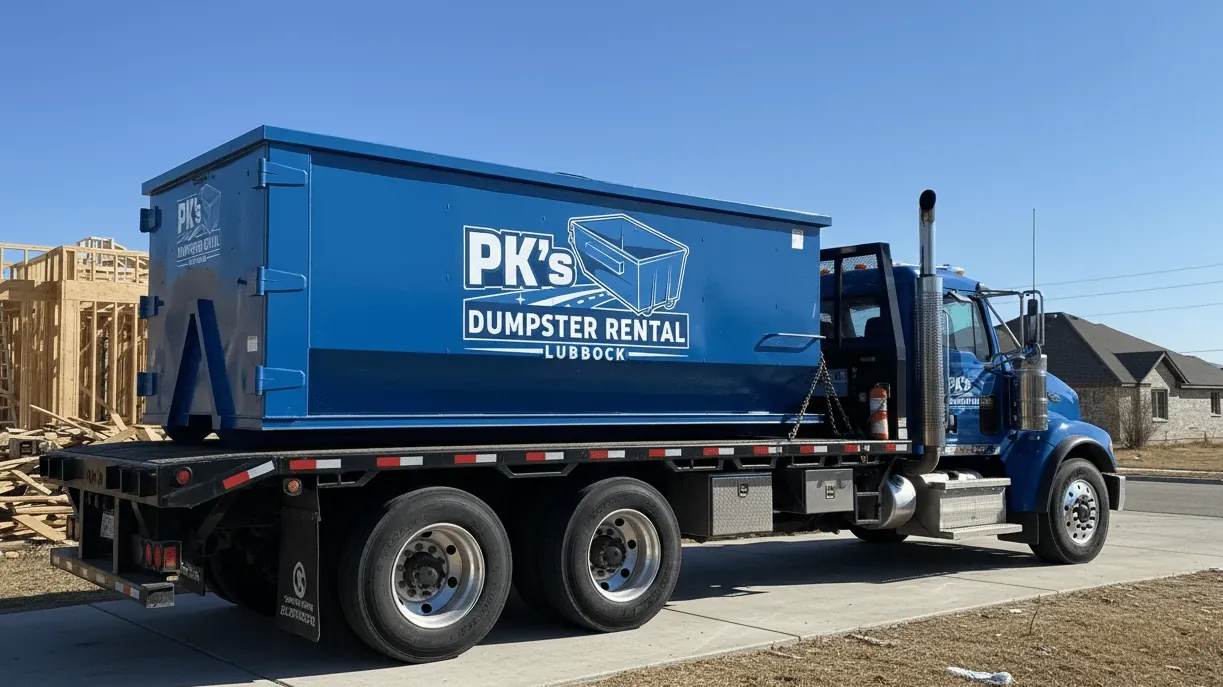
The question I get asked most on the phone, right after size and price, is some version of "is that thing going to wreck my driveway?" The honest answer is that a roll–off will not hurt a sound driveway if it is set down properly, on boards, in the right spot, in the right weather. Nearly every driveway I have seen damaged in ten years on the South Plains went one of four ways — a box set on soft or saturated ground, a box across a crack or control joint that was already failing, a box on gravel or caliche with nothing under the rails, or a driver in a hurry who did not walk it first.
The physics: rails and wheels, not the truck rolling past
People picture the truck as the threat. It is heavy and it backs over the apron. But a truck spreads its weight across ten or more tires on a wide axle spread, and it keeps moving.
The container is a different animal. A roll–off sits on two long steel runners with a set of small rear wheels, and loaded, all of that weight rests on a handful of contact patches that do not move for a week. A 20 yard box of shingle tear–off, or a 10 yard of broken slab and brick, is a serious point load sitting exactly where the rails and wheels touch down. On dense material — concrete, block, caliche, dirt — weight fills a container long before volume does, which is why a 10 yard dumpster is the right can for a concrete and heavy debris job rather than something bigger.
There is a second, sharper moment: the drop and the pickup. The box rolls back on those small wheels and settles, and on the way back there is a brief drag. That is when bare concrete gets a scuff and bare caliche gets a divot. Everything we do is aimed at those contact patches.
Protection boards under the rails, standard
Every container we set goes down on protection boards under the rails and rear wheels. It is not an add–on, not a line item, and you do not have to ask. Boards do one job: they take a point load and spread it over square feet instead of square inches, and they keep steel off your finish.
The second half of the routine is a camera. Our driver photographs the slab before the box comes off the truck and again after we pull it — not to build a legal defence, but so nobody is standing on a driveway three weeks later arguing about whether that hairline crack was there before. Most Lubbock drives over about twenty years old already have some cracking, and the photos settle it in ten seconds. Ask the driver if you want copies.
Lubbock ground: concrete, caliche, gravel, clay
What sits under your wheels here is not what sits under them in Dallas or Denver. The hardpan caliche layer runs under most of the South Plains, and out past Loop 289 caliche drives, pads and county roads are normal. Dry caliche is close to rock — set a loaded 30 yard on a well–built caliche pad and you will see nothing all week. Wet caliche is a different material. It goes greasy, it ruts under a wheel, and the ruts set up hard and stay for years.
Gravel and sand drives have the opposite problem: nothing to break, everything to move. The rails push gravel aside and you will be raking it back. Parts of the region carry expansive clay that swells and shrinks with moisture, which is why so many slabs here move at all. And in the older neighbourhoods — Tech Terrace, the Overton area, central Lubbock — you are often on 1940s and 1950s concrete, thin by modern standards and already mapped with hairline cracks.
| Surface | Risk | What we do | What you can do |
|---|---|---|---|
| Newer poured concrete | Scuffing, rust staining, minor spalling | Boards under rails and wheels, slow set–down, photos | Sweep it clean; point out the control joints |
| Older concrete, 1940s–1970s | An existing crack widening or a corner breaking | Extra boards; never set across a crack or joint | Show us the cracks; consider a smaller can or the street |
| Caliche drive or pad | Ruts and divots when damp, permanent once dry | Full board set; refuse a drop on saturated caliche and reschedule | Watch the forecast and hold a day after real rain |
| Gravel or sand | Displacement, rails sinking, gravel shoved aside | Wide boards to float the rails, straight approach | Have a rake ready; add plywood for a long rental |
| Asphalt | Indentation and gouging, worst on a hot afternoon | Boards plus extra plywood; set in the cooler hours | Lay your own sheets; avoid the softest sections |
| Bare yard, clay or dirt | Sinking, deep ruts, a truck that cannot get out | Assess on arrival and say plainly if it will not hold | Have an alternative ready — slab, caliche pad or street |
| Pavers or stamped concrete | Cracked units, shifted bedding sand, ruined finish | Recommend against it and find another spot | Plan for the apron or the street; do not gamble on the good work |
Rain and the days after
Rain is scarce here and then it is not. After a real storm the ground stays soft longer than people expect, and the day after is often worse than the day of. I would rather move your delivery a day than leave you looking at ruts for the next decade. That is not us being difficult about a same–day dumpster rental — it is the cheapest decision either of us makes that week. Check the National Weather Service forecast before a drop on unpaved ground and call us if it looks marginal.
Hard freezes and stressed slabs
February 2021 did more to Lubbock property than most people credit. Uri burst pipes across the region, and the freeze–thaw cycling in that storm and the hard freezes since have opened cracking in slabs, drives and aprons that were fine before. Plenty of the concrete I set boxes on now is carrying damage from that week. It does not mean your driveway cannot take a container. It means the walkthrough and the photographs matter more than they did fifteen years ago.
Picking the spot
Level ground, first and always. A container on a slope wants to move, and material inside shifts to the low end. Beyond that:
- Back from the apron edge, not overhanging it. Apron edges and driveway corners are the thinnest, least supported concrete on the property, and they are what breaks.
- Clear of the garage door swing and any side door you use daily. A 30 yard box is longer than people picture it.
- Never over a septic tank, leach field or well head — common out toward Woodrow, Wolfforth and Shallowater. A loaded box can crush a tank lid or compact a field beyond repair.
- Off sprinkler heads, irrigation lines and any French drain. Call Texas 811 before you dig, and tell us where private lines run, because 811 does not locate those.
- Not straddling a control joint or an existing crack. Joints exist so concrete can move; a point load across one is asking it to fail there.
Look up as well as down
The hoist arm goes well above twenty feet when the box comes off — higher than most people picture standing in their own driveway. Service drops to the house, low limbs, gutter runs and the basketball hoop over the garage all sit in that arc. Every tree in Lubbock was planted by somebody, and the ones planted in 1955 over a driveway are the ones that make us reposition. If the arm cannot come up clean, the box does not come off there.
The approach: about 60 feet and 10.5 feet
To set and retrieve a container we want roughly sixty feet of straight run and about ten and a half feet of width, plus that overhead clearance. That is the truck's working envelope, not a suggestion. Narrow alleys behind the older streets near campus, tight gated entries off Milwaukee and Frankford, and cars parked opposite a driveway are what most often cost us the straight run. Send a photo of the approach when you book and we will tell you before the truck rolls; our roll–off dumpster rental page covers the equipment side.
The street as the alternative
When the driveway will not work — decorative concrete, a septic field, a slab you will not risk — the street is the fallback. It changes the paperwork, because you are occupying public right–of–way, which generally means a permit and often reflective markings or cones. Rules differ between the City of Lubbock, the surrounding towns and Lubbock County, and they get amended, so confirm the current requirement with the relevant office rather than taking a blog's word for it. The detail is in our guide to dumpster permits in Lubbock.
Boards you can add yourself
Our boards handle a normal job. For a long rental, a heavy load, or a driveway you are genuinely precious about, add a layer of your own. Two or three sheets of three–quarter inch plywood where the rails and rear wheels land, or a run of two–by–tens, spreads the load further and takes the abuse of loading traffic too. Lay it before we arrive and tell the driver so he sets down on it rather than beside it. On a roofing dumpster for a full tear–off, the plywood also saves your slab from the nails and shingle grit that miss the box.
The wind angle
Lubbock is one of the windiest cities in the country, and that belongs in the placement decision, not just the loading one. We orient the container so the open end is not facing straight into the prevailing wind, and where there is a choice we put the house, a fence or the garage between the box and the open side of the lot. It costs nothing and saves you chasing insulation and shingle wrappers down the block on a 40 mph afternoon. The rest of that argument — heavy on top of light, everything below the rails, tarp or net anything that flies — is in our piece on securing your load against Lubbock wind and dust, and it counts double during hail and storm damage cleanup.
What to do before delivery day
- Move the cars the night before, not the morning of. A blocked driveway turns into a return trip.
- Mark the exact spot with a cone, a stake or a chalk outline and text us a photo. Ten seconds of your time removes all the guesswork.
- Unlock the gate or send the code, and confirm the opening is wide enough.
- Tell us what is soft, cracked or buried — the septic tank, the irrigation line, the corner that has been crumbling for two years, the spot that stays wet.
- Clear the path and the overhead: trash cans, low limbs, the trailer parked halfway down the drive.
- Size it honestly. A right–sized can is a lighter can — our dumpster size guide and the walkthrough on what size dumpster you need in Lubbock will get you there, and a 20 yard dumpster covers most remodel work.
One caveat on all of it: no photo tells you everything. We walk the placement with you at delivery, and if the spot you picked will not work — too soft, too cracked, no overhead, no straight run — the driver will say so and offer the alternative. Better a two–minute conversation in your driveway than an awkward one about your concrete a week later.
If you want to talk through a placement before you book, or you have a drive you are worried about, call PK's Dumpster Rental Lubbock at (806) 758-7942 or send a photo of the spot through our contact page. We have been setting boxes on Lubbock concrete and South Plains caliche since 2015, protection boards come standard, and we will tell you straight if a spot will not work.
Questions this guide did not answer? Call (806) 758-7942. We would rather spend two minutes on the phone than have you order the wrong container.