
Permits
Do You Need a Permit for a Dumpster in Lubbock, TX?
A Lubbock operator's breakdown of when a dumpster needs a permit and when it does not, covering city right-of-way, surrounding South Plains towns, county roads, TxDOT highways, demolition and HOA rules.
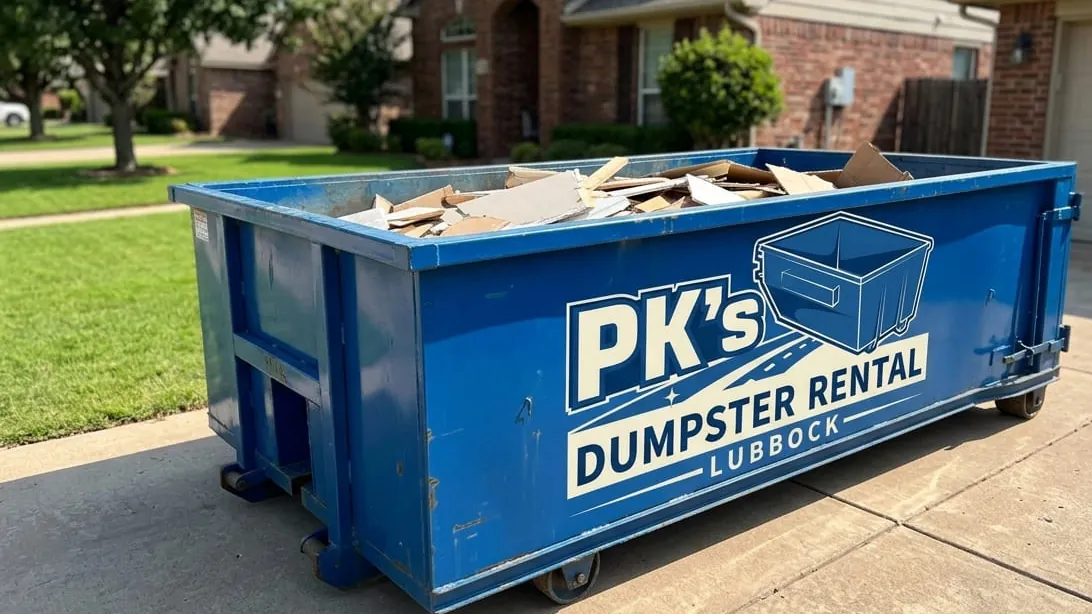
Nine times out of ten the permit question answers itself before I finish asking where the box is going. If the container sits on your own driveway, your own slab, your own caliche pad out in the county, you are almost certainly not pulling a permit. The trouble starts the moment somebody says "we'll just put it in the street" — at that point you are occupying public right-of-way, and that is a different conversation with a different office.
Here is how it actually works across Lubbock, Lubbock County and the South Plains towns, plus the permits people forget entirely: the demolition permit, the building permit for the work underneath, and the deed restriction that outranks both in a new subdivision off Milwaukee.
On your own property: generally no permit
The large majority of drops we make never touch public property. A 20 yard box on a two-car driveway in Tech Terrace, a 30 yard on a builder's lot off Frankford, a 40 yard on a caliche pad beside a shop south of Woodrow — none of that is a permitted activity in the ordinary case. The container is temporary equipment on private land, the same as a scaffold or a portable toilet.
What matters there is not paperwork. It is surface, access and wind. We set protection boards under the rails as standard on every residential dumpster rental, and there is more in our guide to protecting a driveway during delivery.
One firm caveat: municipal codes get amended, and a city can add a private-property placement rule or a duration limit at any council meeting. Confirm the current rule with the jurisdiction you are in before you book.
The street and the right-of-way: this is where it changes
Put a roll-off on a public street, in a parking lane, on a sidewalk or anywhere in the platted right-of-way and you are obstructing public property. In the City of Lubbock that generally means a right-of-way or obstruction permit, typically through the department that oversees streets and traffic, sometimes with a traffic control plan attached if the street carries real volume. Start at the City of Lubbock and ask for the office that issues right-of-way obstruction permits.
Expect them to want the address, the exact footprint of the box, the dates on and off, proof of insurance, and what the container is for. Lead time is the part people underestimate. An application filed the day before a Saturday tear-off is not going to save the job. Requirements, fees and review times change, so call and confirm rather than assuming this still reads the same way.
Where it is going, who you ask, what they want to know
| Where the container is going | Who you ask | What they typically want to know |
|---|---|---|
| Your own driveway or private lot inside Lubbock city limits | Generally nobody — but check your HOA or deed restrictions | Nothing from the city in the ordinary case; HOA may ask duration and placement |
| A public street, alley, parking lane or sidewalk in Lubbock | City of Lubbock, right-of-way / obstruction permit | Address, exact footprint, on and off dates, insurance, traffic control, reflectors or barricades |
| A street in Wolfforth, Shallowater, Slaton, Idalou, New Deal, Abernathy, Levelland, Brownfield, Littlefield or Post | That town's city hall or public works — each runs its own process | Their own form, fee and lead time; Lubbock's answer does not transfer |
| A county road or private drive in unincorporated Lubbock County | Lubbock County — road and bridge or the permit office | Whether the box encroaches on county road right-of-way; driveway culvert and approach condition |
| A state highway or its frontage – US-84, US-87, US-82 and the Marsha Sharp Freeway, Loop 289 frontage | TxDOT, plus the city or county | Right-of-way use, traffic control, sight distance, frontage road access |
| An apartment, duplex or campus-area rental with a shared drive | The property owner or manager, in writing | Which parking spaces come out of service, dates, pavement liability |
| Any demolition, full or partial | City or county building official, plus the state for asbestos | Demolition permit, structure age and type, NESHAP inspection and notification |
| Anywhere you are digging, coring or pulling out foundations | Texas 811, before the work starts | Dig site, dates, type of excavation; then wait out the notice period |
Every town out here runs its own process
This is the most expensive assumption I see. Lubbock is not the South Plains. Wolfforth is its own city with its own ordinances, its own city hall and its own idea of what a right-of-way permit requires. So are Shallowater, Slaton, Idalou, New Deal, Abernathy, Levelland, Brownfield, Littlefield and Post. Some handle a street placement over the counter in twenty minutes. Others want a written application, a certificate of insurance and several business days.
None of that is predictable from Lubbock's rules. Call that town's city hall directly. We cover the whole footprint — see our South Plains service area — and we will tell you what we have run into lately, but the current answer comes from their office, not from us and not from a national website.
Unincorporated Lubbock County
Out past the Loop, most drops are on private ground and the permit question is usually moot. What changes is what the county cares about: whether the box or the truck encroaches on county road right-of-way, whether the drive approach and culvert can carry a loaded roll-off, and on-site septic. Start with Lubbock County for road, driveway and on-site sewage questions, and confirm current requirements — county policies change too.
On a rural property, flag the septic tank, the leach field and the well head before delivery day. Paint, stakes, cones, anything visible. An empty 40 yard box is heavy before a single shingle goes in it, and a loaded truck crossing a leach field is a mistake no permit would have prevented. Same goes for buried propane lines and old irrigation runs.
State highways bring TxDOT into it
If the property fronts a state facility, the right-of-way is not the city's to permit. US-84 — Clovis Road on the northwest side and the Slaton Highway on the southeast — US-87, US-82 and the Marsha Sharp Freeway, and the Loop 289 frontage roads are all TxDOT. Placement in that right-of-way generally means going through TxDOT on top of whatever the city or county wants. Sight distance and traffic control matter more there, and lead times are longer. Confirm with the district office before you commit to a date.
Texas 811 before you dig or demolish
This one is not optional. Before excavation, before pulling a foundation, before coring a slab or setting a post, notify Texas 811 and let the locate period run. It is free, and hitting a gas line in a Lubbock alley is a day nobody recovers from quickly. Notice windows and marking rules are set by state law and can be revised, so check current requirements each time rather than going from memory.
Demolition, NESHAP and asbestos
Demolition is where the paperwork gets real. Taking down a structure — house, garage, shop, commercial building — generally requires a demolition permit from the building official, and demolition generally triggers a NESHAP inspection and notification. In Texas, asbestos is regulated by the Texas Department of State Health Services under the Texas Asbestos Health Protection Rules, which govern who may inspect, who may abate and what notice is required.
This matters here because of the housing stock. Tech Terrace, the Overton area and central Lubbock are full of 1930s through 1950s houses, and pre-1980 construction turns up asbestos in floor tile and mastic, popcorn and textured ceilings, pipe wrap and roofing felt. Pre-1978 houses carry lead paint under the EPA RRP rule. We cannot take asbestos-containing material in any container, in any quantity. That goes through a licensed abatement contractor. Our demolition debris container handles the clean material once abatement is signed off. Verify current requirements with DSHS and your building official before demolition day.
Building permits for the work underneath
The container is the easy part. The permit that actually gates the project is the building permit for the work itself: reroofing, additions, structural changes, slab work, electrical and mechanical. Hail season runs roughly March through June, and after a serious cell the entire roofing trade books at once. That is exactly when people call for a roofing dumpster without having dealt with the permit yet. Sort that first; the box can be there next morning. Larger builds are the same — see our construction dumpster rental page.
HOAs and deed restrictions outrank the city
In the newer developments in south and west Lubbock — past 98th, west of Milwaukee, the subdivisions off Frankford and Upland — the city may have nothing to say about your driveway while the HOA absolutely does. Common restrictions cap how many days a container may sit, require driveway-only placement, prohibit the street entirely, and sometimes require written notice to the board. Deed restrictions can survive whether or not the association is active.
Read your covenants before you book, not after the letter arrives. On a short leash, size the container so you only need it once. Our guide to choosing a dumpster size in Lubbock walks through it, and a 40 yard roll-off on one pull often beats two smaller loads.
Rentals and the campus area
North and east of Texas Tech, through Tech Terrace and around Maxey Park, most of the housing is rental. If you do not own the property, you need the owner's written approval before a box goes down — and on duplexes, fourplexes and anything with a shared drive, you need to know whose parking spaces are coming out of service. May move-out and August move-in are the busiest weeks of the year here; more on that cycle in our notes on rental property turnover cleanouts. Get the approval in an email.
The things that are not permits but will still stop the job
Half the failed deliveries I have seen had nothing to do with a permit office. A roll-off truck needs roughly 60 feet of straight approach to set and retrieve a box, and around 22 feet of overhead clearance to raise the bed. Low limbs on those planted elms and hackberries, service drops to the house, carport headers and gate arches all end a delivery on the spot. So does somebody's car parked at the end of the driveway.
Surface matters too. A caliche drive is solid dry and soft for a day or two after a real rain, so if the forecast is wet, tell us and we will talk about staging. And because this is Lubbock, load discipline is part of the deal: heavy on top of light, everything below the rails, and tarp or net anything that can fly, because a 40 mph afternoon will spread a box of insulation and shingle wrappers across three streets. See our piece on securing a load against wind and dust, and our Lubbock County materials guide for what can go in the box.
What happens if you skip it
Nothing dramatic, usually, right up until it is. The realistic outcomes are a code enforcement citation, an order to move the container at your cost and on their timeline, or a driver who will not set the box because the placement plainly is not legal. On a state right-of-way it escalates faster. None of that is worth the twenty minutes a call to city hall takes.
Call before you book
We have been setting containers on the South Plains since 2015, and we will tell you straight whether your placement needs a permit, what the town you are in has wanted lately, and how to stage the drop so the truck can get in. We cannot pull the permit for you — that is between you and the jurisdiction — but we can save you a wasted trip. Call PK's Dumpster Rental Lubbock at (806) 758-7942 or use our contact page, tell us the address and where you want the box, and we will handle the rest.
Questions this guide did not answer? Call (806) 758-7942. We would rather spend two minutes on the phone than have you order the wrong container.