
Cleanouts
Estate Cleanout Checklist for a Lubbock Home
Clearing a parent's house in Lubbock, in the order that keeps you out of trouble: secure and search first, protect the paperwork, appraise before you haul, then bring the container.
Clearing out a parent's house is a job, and treating it like a job is the kindest thing you can do for everybody in that living room. The families who get through it without a fight are the ones who worked in the right order.
Do not start by throwing anything away. The order is: secure the house, search it, appraise what has value, distribute to family, donate what is usable, and only then dispose of the rest. A house lived in for forty years is not sorted, it is layered, and the valuable things are not on the counter. They are in a cake tin, in a boot, in the bottom of a toolbox. So order the container for the back half of the job. On a normal estate cleanout in Lubbock the box lands in week two, not on the first Saturday.
Probate and the executor set the pace
Before anything of value leaves the property, know who has authority to move it. That is the executor named in the will or the administrator appointed by the court — not the child who lives closest, not the one with a key. Texas probate has its own machinery — independent administration, muniment of title, small estate affidavits, and a filing window for a will that does run out. Household goods are the easy part; anything with a title, an account number or a mineral interest attached is not. Ask the attorney handling the estate what you are cleared to sell or discard before the truck comes. Procedure changes and county practice varies, so confirm with that attorney or Lubbock County rather than taking anyone's word for it, ours included.
Secure the house, then search it
Day one is locks and inventory, not hauling. Change the locks, collect the garage remotes, retire the hide-a-key, forward the mail. Then search. Older West Texas households do not use a safe. They keep them in coffee cans on the shop shelf, in the freezer wrapped in foil, taped under a drawer, in a Bible, in the toolbox tray. Nothing leaves the house unsearched. Every book gets fanned, every coat pocket checked, every tin opened, the freezer emptied by hand. Handle these the first day:
- Firearms and ammunition — unloaded, secured in one place, one person responsible. Transfer follows federal and state rules; the attorney tells you how they pass.
- Prescription medication — never the container, never the toilet. Pharmacy or law enforcement take-back.
- Jewellery, coins and currency — off site and logged before an estate sale company or an extra helper walks in.
The paperwork that must never go in the container
This is the category families lose. A file drawer looks like clutter after four hours of sorting and goes out with the rest. Box every scrap of paper and let one person read it later:
- Deeds, abstracts and survey plats
- Mineral deeds, royalty statements, division orders and lease paperwork. Common in this part of Texas and genuinely thrown away by mistake. A royalty statement looks like junk mail. It is not.
- Water rights and irrigation well records
- Farm records: crop and FSA paperwork, equipment titles and serial numbers
- Life, burial and property insurance policies, including old paid-up ones nobody remembers
- DD-214 military discharge papers — needed for burial benefits and a nuisance to replace
- Paper savings bonds, stock certificates, tax returns, titles, safe deposit keys
Anything with an account number gets shredded, not binned. A container sits in an open driveway in one of the windiest cities in the country, and paper travels.
What a Lubbock house actually holds
There is no basement here. Lubbock is slab-on-grade, brick veneer over frame, so forty years of accumulation lives in four places:
- The garage. Two-car, usually with no car in it. Paint, chemicals, lawn equipment, boxes, a spare freezer, a workbench.
- The attic. Decades of boxes on loose decking. Work it early morning, never a July afternoon, two people minimum, and test the decking first.
- The backyard shed. Fertiliser, fuel cans, tools, hoses, a mower that has not run since 2011.
- A shop or metal outbuilding if the place is out in the county — often the biggest single volume on the job.
- The rented storage unit off 82nd or the Slaton Highway that nobody has opened in six years and has been paid by autodraft the whole time.
A few older properties have a small storm cellar. It is not a basement, it is damp, and what is down there has probably not survived.
Farm and ranch estates out in the county
A farmstead is a different animal: equipment, shop tools, welders, rolls of fencing wire, T-posts, baling twine, irrigation pipe and a scrap pile growing since the 1970s. Scrap steel is worth money and worth separating — pipe, implements, sheet metal and cast iron go to a scrap yard, not a box you are paying to haul.
And agricultural chemicals and fuel never go in a container. Herbicide and pesticide jugs, treated seed, unlabelled drums, diesel in barrels, used oil and filters, antifreeze, tractor batteries and old tyres all need proper handling. The TCEQ publishes guidance on agricultural waste, and county hazardous waste events take the smaller material. Unlabelled drums are a call to make, not a guess to take, and accepted materials change, so confirm first.
Get one honest opinion before you haul
Have somebody who knows the market walk the house before the first load leaves. One opinion costs an afternoon and keeps real money out of a roll-off. Worth a second look: solid wood furniture, as against 1990s particle board; hand tools, older American-made power tools and shop equipment; Western and ranching material such as saddles, tack, bits, spurs, branding irons, chaps, ropes, boots and hats; firearms and reloading gear; coins, currency and sterling; and quilts, linens and hand work, which get binned constantly and are frequently valuable.
Then pick a route, and most estates use all three. An on-site estate sale suits a full house with broad contents: the company prices, staffs and runs a weekend for a commission and leaves you the leftovers. An auction is better for equipment, vehicles, tools, guns and collections, and an on-site farm auction is normal for a county place. Donation takes the clean, usable middle through charity resale stores and church programmes, with cabinets, fixtures and working appliances going to a building-materials resale outfit.
Sort room by room
One room finished before the next is opened. Four categories only: keep and distribute, sell, donate, dispose. Painter's tape on the item, index cards on furniture, a photo of every room before you empty it. Stage in the garage, not the driveway — here an open pile relocates itself by dinner. And appoint one decision-maker per room, named in advance, with everyone else agreeing to defer. That single rule prevents most of the arguing.
| Room or building | What is usually in it | Where it goes | Watch out for |
|---|---|---|---|
| Kitchen | Cookware, small appliances, canned goods | Donate usable, container for the rest | Cash in coffee cans, rings in cupboards, freezer contents |
| Bedrooms and closets | Clothing, linens, shoes, dressers | Donate clean textiles, bin the rest | Coat pockets, boot toes, quilts, papers under drawer liners |
| Living and dining | Furniture, china, glassware, art | Distribute, estate sale, donate | Photos and documents behind frames and inside books |
| Office or den | Files, bank records, bonds | Box it all, read later, shred account numbers | Mineral deeds, royalty statements, DD-214, insurance policies |
| Bathrooms | Toiletries, expired medication | Container for most of it | Prescriptions to a take-back; sharps separately |
| Garage | Paint, chemicals, tools, boxes, freezer | Sort, sell the tools, container for bulk | Paint, fuel and refrigerant appliances are prohibited |
| Attic | Boxes, luggage, decorations, insulation | Sort on the ground, container for the rest | Heat, loose decking, light material that flies out |
| Backyard shed | Fertiliser, fuel cans, mower, hoses | Container for hard goods only | Fuel, propane and lawn chemicals go to the station |
| Shop or outbuilding | Welders, tools, wire, twine, oil, scrap steel | Auction the tools, scrap yard for the metal | Used oil, ag chemicals, tyres and batteries stay out |
| Storage unit | Furniture and boxes nobody has opened | Same four-category sort, on site | Search it first; it often holds the paperwork |
Sizing, sequencing and the wind
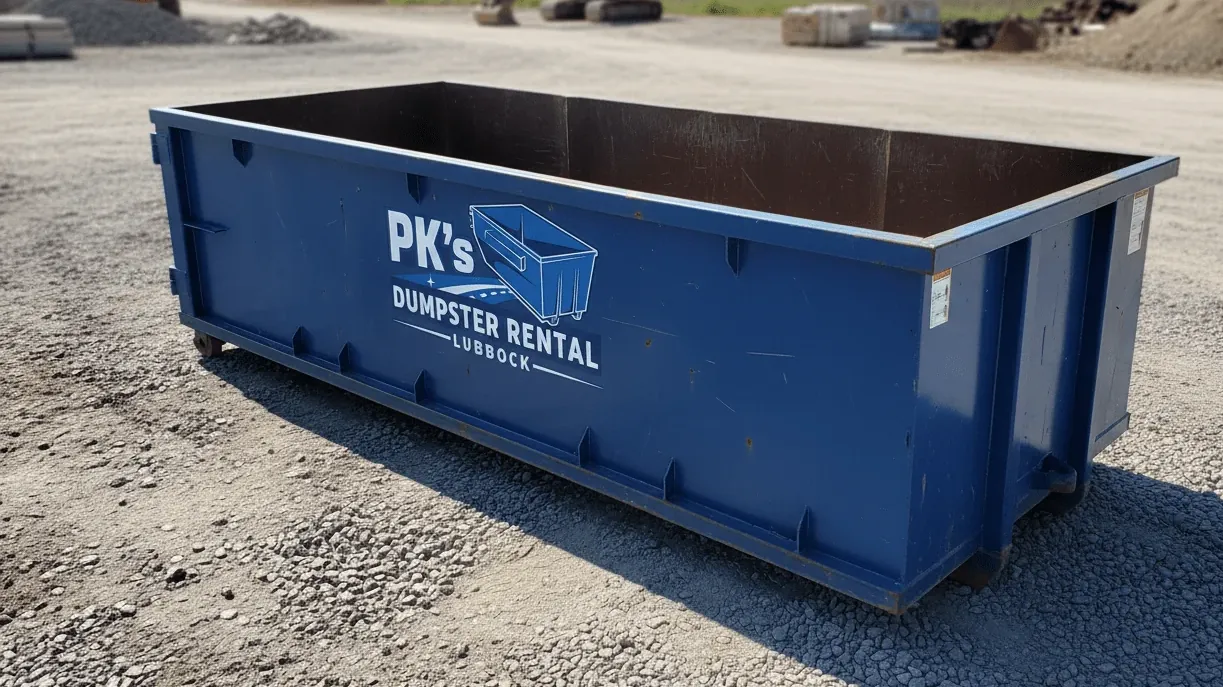
For a typical Lubbock house we usually set a 20 yard container for the first pass and swap it, rather than dropping one 30 yard and living with it for a month. Walls on a 20 are low enough to load over the side by hand, the footprint fits a Tech Terrace driveway, and the swap is a natural checkpoint: when the first box goes you decide honestly whether you still need the same volume. Go bigger for a farmstead or a forty-year shop. A 10 yard suits an apartment or the final sweep after the sale, and our Lubbock dumpster sizing guide covers the rest.
Then the wind. A container half full of light household goods — clothing, curtains, packing paper, foam, cardboard — will empty itself across the block on an ordinary 40 mph afternoon. Load heavy on top of light, keep everything below the rails, bag light material rather than tossing it loose, and cap the load every night. Our write-up on securing a load against Lubbock wind covers the method.
Pre-1980 houses, and what cannot go in the box
Central Lubbock, Tech Terrace and the Overton area are full of 1930s through 1950s stock. Removing contents is no problem, but if the job turns into a remodel — pulling 9x9 floor tile and black mastic, scraping a textured ceiling, cutting into pipe wrap — stop and have it tested first. Asbestos in Texas is regulated by the Texas Department of State Health Services under the Texas Asbestos Health Protection Rules, and demolition generally triggers a NESHAP inspection and notification even when nothing turns up. Pre-1978 homes also carry lead paint under the EPA renovation rule. We cannot accept asbestos-containing material in any container, and these rules are updated periodically, so confirm current requirements with DSHS.
Estate cleanouts produce more prohibited material than any other residential job, because a garage filling since 1985 is where it ended up. Keep out paint, stain and solvent; pesticides, pool chemicals and fertiliser; motor oil, antifreeze, fuel and propane cylinders; tyres and lead-acid batteries; electronics, televisions and CRT monitors; any appliance holding refrigerant, which needs certified recovery first; plus sharps and ammunition. The City of Lubbock citizens collection station takes much of it from residents, and the county holds household hazardous waste events. Note that Texas has no statewide paint stewardship programme, so there is no retail paint drop-off network here the way there is in some states. Dry latex solid and handle it as ordinary waste; oil-based paint and solvents go to the station. Hours and accepted items change, so check with the City, and our guide to what can go in a dumpster in Lubbock County has the full list.
Pace it
Do this over weekends, not one exhausting push. Six hours is a full day; past that people stop making good decisions and start throwing things they will want back. Somebody will find a letter and need twenty minutes with it. Let them have it. Bring gloves, dust masks, boots, box cutters, bags and tape, and keep small children off site while the box is on the drive. If the house is going on the market, the last pass looks like a standard home cleanout, and a junk removal crew can take the heavy furniture if the family cannot lift it.
When you are ready, we deliver same day or next day across Lubbock, Lubbock County and the South Plains, with next-day swaps when the first box fills faster than expected. Call PK's Dumpster Rental Lubbock at (806) 758-7942 or use our contact page; tell us what the house is and where you are in the process, and we will tell you what size to start with and when to have it dropped. Take the time you need — the box will be there when you are ready for it.
Questions this guide did not answer? Call (806) 758-7942. We would rather spend two minutes on the phone than have you order the wrong container.