
Loading Tips
Wind and Dust: Securing Your Dumpster Load in Lubbock
Lubbock is one of the windiest cities in the country, and that changes how a roll-off has to be loaded. Here is the method that keeps debris in the box and off the neighbours' lawns.
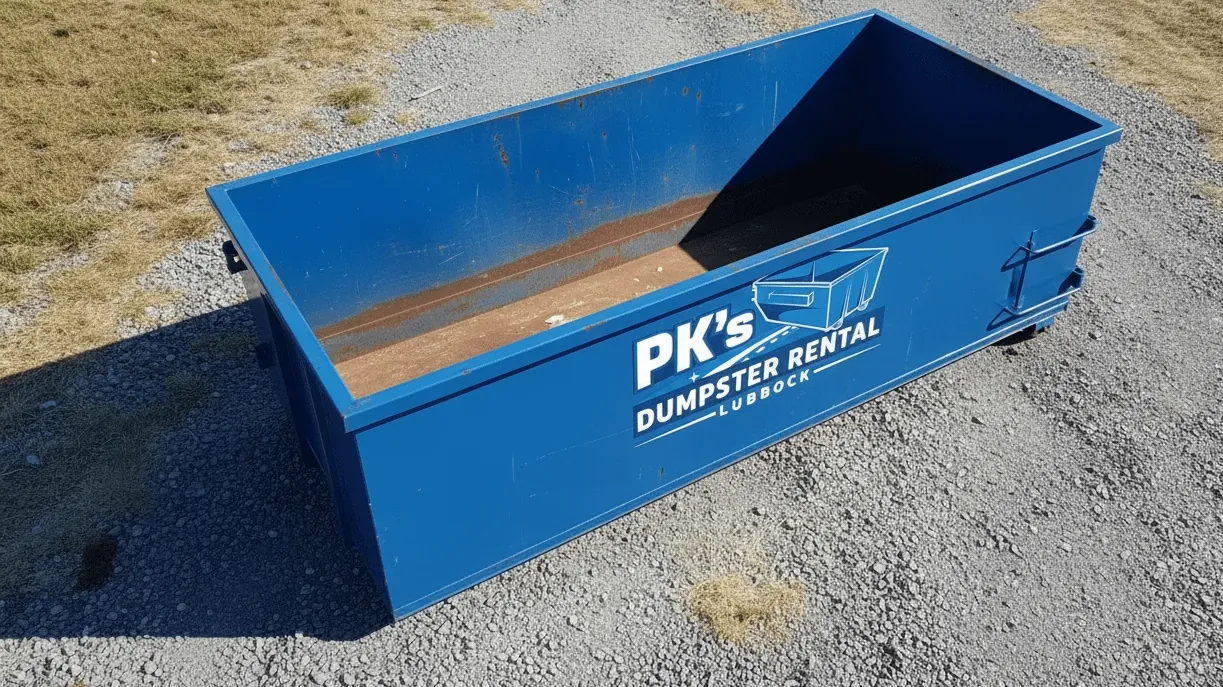
Most dumpster companies tell you to keep the load level and not to overfill. Everywhere else, an overfilled container is a paperwork problem. On the South Plains it is a physics problem. Lubbock sits around 3,200 feet on the Llano Estacado with nothing between here and the Rockies to slow the air down, and it is routinely ranked among the windiest cities in the United States. A steady 20 to 25 mph afternoon is an ordinary Tuesday. Spring afternoons gusting into the 40s and 50s are not unusual, and a gust front off a storm cell can double that in about ninety seconds.
So a 30 or 40 yard container heaped with insulation, cardboard, housewrap and shingle wrappers is not a container of debris. It is a hopper feeding your neighbours' yards. The difference between a job that goes smoothly here and one that turns into a Saturday spent chasing pink fibreglass down the alley is almost always how the load was built in the first ten minutes.
Why Lubbock is different
Three things stack up here that do not stack up in Dallas or Houston.
First, the terrain. The Llano Estacado is flat and almost treeless — every tree in this city was planted by somebody. No ridge line, no forest edge, nothing to break the flow. Wind arrives at your driveway at full speed, and most of the year it arrives from the southwest.
Second, the calendar. March through June is the windy season and it is also hail season, so peak wind overlaps exactly with peak roofing work.
Third, the dust. Blowing dust days and full haboobs still roll across the region, usually ahead of a dryline or a collapsing storm cell. When the horizon turns the colour of a paper bag, anything loose in an open container is already gone. The National Weather Service office here issues wind and blowing dust advisories, and they are worth reading the night before a tear-off, not the morning after.
What actually escapes
It is almost never the heavy material. It is the light, flat, high-surface-area stuff that behaves like a wing:
- Insulation — fibreglass batts are bad, blown-in cellulose is worse. One batt will travel two blocks.
- Housewrap and plastic sheeting — a torn sheet is a sail with a rope handle.
- Cardboard — especially boxes that were never broken down flat.
- Shingle wrappers and roofing felt — the wrappers off a bundle are the single most-escaped item on any roof job in this city.
- Siding and trim offcuts — vinyl drops, thin PVC trim, hardboard slivers.
- Foam board and styrofoam — near-zero weight, huge surface, and unrecoverable once it breaks up.
- Empty buckets, drop cloths, packing material — a lidless five gallon bucket is a tumbleweed.
- Dried leaves and light brush — dry being the operative word out here.
| Material | Likelihood it blows out | How to secure it |
|---|---|---|
| Blown-in cellulose, loose insulation | Extreme | Bag at the source, tie the bags, cap with sheathing or lumber |
| Fibreglass batts | Extreme | Bag or bundle and strap; never the top layer |
| Housewrap, sheeting, drop cloths | Extreme | Roll tight, tie the roll, bury under dense debris |
| Foam board, styrofoam, packing material | Extreme | Bag or break down flat, load low, cap heavy |
| Shingle wrappers, felt, underlayment scrap | High | Bag them at the ladder, not loose into the box |
| Cardboard, paper, packing boxes | High | Break down flat, stack interlocked, weight the stack |
| Vinyl siding and trim offcuts | High | Bundle and lay flat lengthways on the container floor |
| Dried leaves, light brush, clippings | High | Bag, or keep as a separate covered load |
| Empty buckets, cans, small plastics | Moderate | Nest, lid or bag them; never loose on top |
| Loose dirt, caliche fines, ash | Moderate, as dust | Wet down before and after loading, or tarp it |
| Asphalt shingles from a tear-off | Low | Lay flat and interlocked — excellent capping layer |
| Drywall, sheathing, lumber, brick, concrete | Very low | Your ballast — load first, and save some for the top |
The loading method that works here
The rule I give every customer at booking is short: heavy on the bottom, heavy on the top, light in the middle, everything below the rails.
Most people get the first half. Dense material on the floor keeps the load stable and the weight low. What gets skipped is the capping layer. Whatever light material went in during the day needs a lid of dense debris over it before you walk away — a course of tear-off shingles, a few sheets of sheathing, some 2x scrap, a run of drywall. It does not need to be tidy. It needs to be heavy and it needs to cover.
- Load flat and interlocked, not heaped. Long pieces run the length of the box, layers crossing each other. A heaped load has a rounded top that catches air from every angle and cannot be tarped properly.
- Break cardboard down. A knocked-down box is a flat panel. An intact box is a kite with a keel.
- Bag before it goes in. Insulation, packing material, sweepings, small light debris — bag it where it comes out of the building. That is ten times easier than fishing it out of a fence line later.
- Keep it below the top rail. Not a suggestion. A load above the rails cannot be covered, and a load that cannot be covered may not be legally haulable. Practically it means unloading the excess in your driveway or the truck leaving empty.
- Fill the corners. Voids let material shift and rise. A tightly packed box holds its own debris down.
If you keep ending up over the rails, the answer is a bigger box or a swap, not more stomping. Our guide to picking a dumpster size in Lubbock walks through it, and the 30 yard and 40 yard roll-offs exist precisely so bulky light material has somewhere to sit below the rail line.
Tarps and nets
Cover the box any time light material is in it and you are leaving the site — overnight, over a weekend, or whenever there is a wind advisory. On a multi-day tear-off, cover it every evening.
How you secure it matters more than whether you own one. A tarp tied at the corners only is worse than no tarp: wind gets under an edge, lifts the sheet like a parachute, and takes the top of your load with it. Then the tarp is debris too.
- Use a grommeted cover sized to the container, not a bedsheet-grade poly tarp.
- Tie every grommet. Bungees to the lift bar and side pockets work; ratchet straps over the top work better.
- Cargo netting is easier on a bulky, non-dusty load and it lets rain through.
- Weight the southwest edge first — that is where the wind is coming from.
- Check it after any gust front. A cover that peeled at 3pm has been open since 3pm.
Placement: the free windbreak you already own
Half the problem is solved before a single board goes in, by where the container sits.
- Put the house, garage or a solid fence on the southwest side. Even six feet of privacy fence takes a real bite out of ground-level wind.
- Face the swing-door end away from the prevailing wind so the door end is not scooping air into the box.
- Do not park upwind of trouble. A pool, a neighbour's clean yard, a school fence, a storm drain inlet, a playa — work out what is downwind before the truck backs in.
- Mind the drive surface. We set protection boards under the rails on every delivery, which matters on older concrete in Tech Terrace and on caliche drives out past the Loop.
- Street placement changes the rules. If the box has to sit in the right-of-way you are into permit territory; confirm current requirements with the city, because they get revised.
The legal and neighbourly side
Once debris leaves your container it is still your debris, and that surprises people. Escaped material in the street, a ditch or a storm drain is a code and stormwater matter, and the trail leads back to the property that generated it. The city runs a municipal stormwater programme under state permitting through the TCEQ, and any construction site is expected to keep its waste contained. Rules and thresholds change, so check with the City of Lubbock or Lubbock County for the current version before relying on anything here.
There is a bigger reason to care. The playa lakes scattered across the Llano Estacado are the main recharge for the Ogallala Aquifer — the water this whole region farms and drinks on. Runoff carries whatever it picks up into the nearest playa. And on the neighbourly side, nothing sours a remodel faster than a week of the people next door picking your insulation out of their hedges.
Dust, dirt and ash
Dust is its own category. Dirt, caliche spoil, concrete grindings, ash from a burn pile or fine demolition debris will lift off the surface of a container in any real wind, even when nothing is technically blowing out of it. Wet the surface with a hose before you leave it, or cover it. On clean concrete, brick and caliche loads, weight fills the box long before volume does, so you are working with a low flat load anyway — easy to wet, easy to cover.
Burning brush is not the alternative. Burn bans are routine here in dry stretches, so the container is the legal option. Keep clean green waste as a separate clean brush load so it can be ground for mulch rather than buried, and bag the dry leaves.
Timing the work
Wind here has a daily rhythm: mornings are usually the calm part, it builds as the day mixes out, and it peaks mid to late afternoon.
- Do the light-material work early — insulation, housewrap, breaking down boxes.
- Save dense, heavy loading for the afternoon, when it matters less.
- Cap and cover before you lose the light, not at 8am the next day.
- Read the forecast before a big tear-off. A 45 mph gust day is a day for interior demolition instead.
After hail this gets harder, because the whole trade is working at once. Our notes on hail and storm damage cleanup cover the scheduling reality and the tear-off sizing guide covers how much box a given square count needs. In storm weeks a container may sit longer between swaps than you planned, which makes the capping layer and the cover more important, not less. Same during the May and August Texas Tech turnover rush, when rental turnover cleanouts stack up around Tech Terrace and Maxey Park and most of what comes out of those units is light, bulky and badly bagged.
What we do on our end
Placement advice is part of booking, not an afterthought — tell us which way the house faces and what sits downwind and we will spot the box accordingly. Protection boards go under every container as standard. Loads get covered for the haul so nothing comes off the truck between your driveway and the transfer station. And if a load has crept over the rails, we would far rather hear about it before the truck rolls than have the driver make that call in your driveway; a same-day or next-day swap is almost always the cheaper problem. If you are not sure a material even belongs in the box before you worry about securing it, start with what can and cannot go in a dumpster in Lubbock County.
Wind is the one variable in this business you cannot negotiate with — you can only build the load so it does not care. If you want a container spotted where the wind will not get at it, or you want to talk through a tear-off or a cleanout before the windy stretch, call PK's Dumpster Rental Lubbock at (806) 758-7942. We have been running roll-offs on the South Plains since 2015 and we will tell you straight what a load like yours needs.
Questions this guide did not answer? Call (806) 758-7942. We would rather spend two minutes on the phone than have you order the wrong container.