
Sizing
What Size Dumpster Do I Need in Lubbock?
Two rules decide dumpster size in Lubbock: weight beats volume on dense material, and wind beats everything on light material. Real dimensions, honest pickup equivalents and how to describe your job.
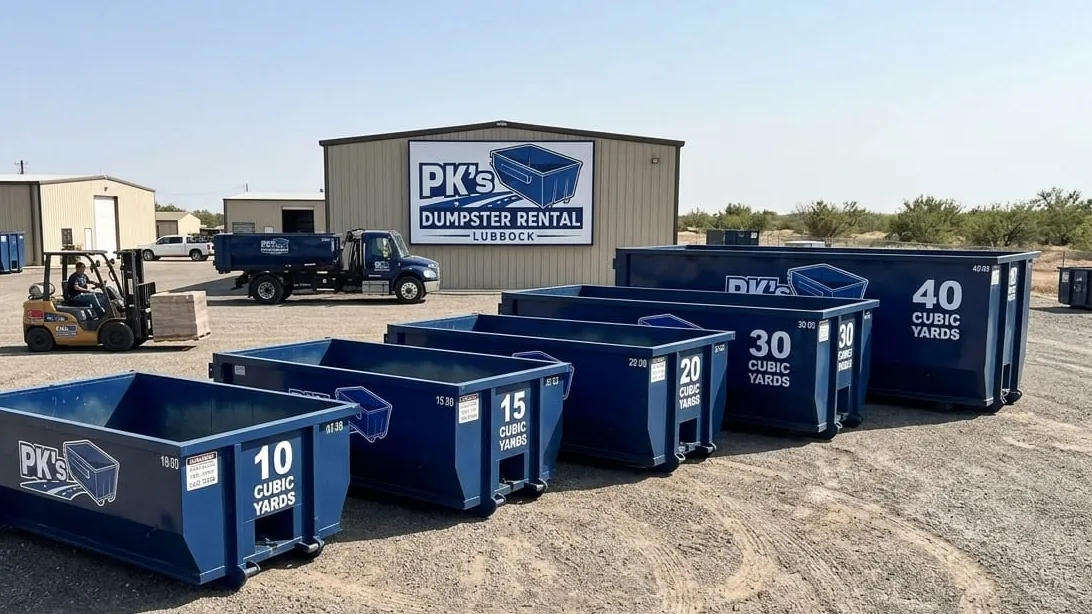
Almost every sizing call starts the same way. Somebody says "I think I need the biggest one you've got," then describes the job, and it turns out to be a bathroom gut with floor tile and a cast iron tub in it. The right answer there is our smallest container, hauled twice. Meanwhile the fellow who says "it's just some old fence and a bit of siding" needs a 30, because his debris is mostly air.
Sizing a roll-off here is not really about how much stuff you have. It comes down to two rules that pull in opposite directions, and once you know which one applies to your pile, the size picks itself.
Rule one: weight beats volume on dense material
Every container has a weight allowance as well as a cubic-yard capacity, and on the South Plains the weight runs out first. Caliche, concrete, brick, block, mortar, tile, dirt and sod all run roughly 2,400–2,800 pounds per cubic yard. A 12 by 12 foot patio slab at four inches thick is about 1.8 cubic yards — call it two and a quarter tons before you touch the walk or the steps.
Fill a 30 yard box with that and you are asking a truck to lift close to forty tons. No roll-off truck on any road in Texas does that, and highway axle limits would end the trip before it started. So dense material goes in a small container and we come back.
Rule two: wind beats everything on light material
Lubbock is one of the windiest cities in the country, and that is not a talking point, it is a loading constraint. A 40 yard box heaped with insulation batts, cardboard, housewrap and siding offcuts will redistribute itself down the block on a 40 mph spring afternoon. The bigger the container, the bigger the sail.
So where a 30 or 40 genuinely is the right call, the size comes with conditions: keep everything below the rail line, cap light material with heavy on top, and tarp or net anything that can fly. Our guide to securing a load against Lubbock wind is worth ten minutes before the first load goes in.
The five sizes, honestly described
Here is what we run, with real dimensions and honest pickup equivalents. A "pickup load" below means a full-size half-ton with an eight foot bed, heaped — roughly two and a half to three cubic yards. Not a level bed, and not a compact truck.
| Size | Dimensions (L x W x H) | Typical weight allowance | Pickup loads | What it is actually for in Lubbock |
|---|---|---|---|---|
| 10 yard | 12 x 8 x 3.5 ft | 2–3 tons | 3–4 | Concrete, caliche, brick, block, tile, dirt and sod. Small bathroom gut. One-room remodel. The dense-material box. |
| 15 yard | 16 x 8 x 4 ft | 3 tons | 5 | Single-layer shingle tear-off on an average house. Garage or storm cellar cleanout. One-bedroom student turnover. Mixed heavy remodel debris. |
| 20 yard | 22 x 8 x 4.5 ft | 3–4 tons | 6–7 | The workhorse. Two-layer tear-off, whole-house cleanout, kitchen remodel, deck and patio cover demo, three-bedroom rental make-ready. |
| 30 yard | 22 x 8 x 6 ft | 4–5 tons | 9–10 | Bulky light material. Framing lumber, siding, cabinetry, fencing, roof decking, small commercial fit-out, hoarding-level estate cleanout. |
| 40 yard | 22 x 8 x 8 ft | 5–6 tons | 13 | Large commercial demolition and fit-out, equipment sheds and outbuildings, big multi-trade construction, whole-shop clearouts. |
Weight allowances vary by material and disposal site, so treat them as planning figures and confirm yours when you book. The dimensions do not vary — those are the boxes on our yard. Full specifications sit on our dumpster size comparison page.
Dense material goes in a 10 or a 15, and gets hauled twice
This is the most useful line in the article. If your debris is concrete, caliche, brick, block, mortar, tile, dirt or sod, you want a 10 yard roll-off or a 15 yard, and you plan on more than one haul. A 10 yard box is at its weight allowance while it still looks half empty, and that visual is what trips people up. It is not underloaded. It is finished.
Caliche deserves its own mention because it is everywhere here. Torn-out drives and trench spoils are heavier than people expect, and heavier still after rain. Same for sod and topsoil off a landscape change.
The workable approach is a clean single-material load in a small box, swapped next day. Clean matters: concrete and masonry with no wood, plastic or trash mixed in takes a better disposal path than mixed debris. Our concrete and heavy debris service exists for this, and we will tell you on the phone how many pulls your slab needs rather than letting you find out on a Saturday.
Shingle tear-off is sized by squares and layers, not by roof area
Roofing is a weight job dressed up as a volume job. Ask a roofer and they will talk in squares — one square is 100 square feet of roof surface. A square of three-tab asphalt runs roughly 230–250 pounds; architectural and dimensional shingle runs heavier, often 400 pounds or more per square, and Lubbock has plenty of impact-rated dimensional product on it after two decades of hail claims.
Then multiply by layers. Plenty of houses in central Lubbock, Tech Terrace and the Overton area carry two, occasionally three, and nobody knows until the first course comes off. Roughly: 20 squares single-layer fits a 15 yard; 25–30 squares or any two-layer job wants a 20 yard container. Add decking replacement and the volume jumps while the density falls.
Hail season runs roughly March through June, and after a serious cell the whole roofing trade books at once. Working a claim? Schedule the container the same day you get the adjuster's number. We keep roofing containers staged for that season, and our roofing tear-off sizing guide goes deeper. Anyone with an open roof should be watching the National Weather Service forecast.
Bulky light material wants the big box — with a lid on it
The other half of the picture. Framing lumber, roof decking, siding, cabinetry, interior doors, fencing, carpet and pad, furniture and commercial fit-out debris are volume-heavy and weight-light — you will fill 30 cubic yards long before you approach four tons. A fence flattened by straight-line wind is the classic case: enormous pile, almost no weight.
Here the 30 yard and 40 yard containers earn their keep, and a smaller box just means paying for hauls you did not need. But this is exactly the load Lubbock wind will scatter across three neighbours' yards. Cap it, keep it under the rails, tarp it at the end of every working day, and put the box on the downwind side of the house if the approach allows.
No basements — which is why northern sizing guides overshoot here
Most dumpster sizing advice online was written for markets where a cleanout means a basement. Lubbock houses are slab-on-grade, brick veneer over wood frame — no basement, and a handful of older properties have a small storm cellar and nothing more.
Volume in a Lubbock cleanout comes from three places instead: the garage, the attic and the backyard shed. A two-car garage untouched for fifteen years produces a startling amount, and dry attics here hold decades of boxes. It still adds up to less than a full basement, so a 20 yard handles most whole-house cleanouts where an out-of-market guide would have said 30. Our room-by-room home cleanout checklist walks through what a garage, attic and shed actually produce.
The Texas Tech turnover
A student rental make-ready is almost always a 15 or a 20. A one-bedroom or a lightly used unit fits a 15; a three or four bedroom house near campus with furniture, mattresses, a couch nobody claims and carpet coming out is a 20. That is a stable, predictable number and it has not moved much in ten years.
The complication is calendar, not size. Every landlord in Tech Terrace, Maxey Park and the streets north and east of Texas Tech University needs a container the same fortnight in May, and again in August. Book weeks out. With several units, one staged container on sequenced next-day swaps beats four boxes on one morning — more in our notes on rental turnover cleanouts.
Farm and county work past the Loop
Equipment sheds, shop cleanouts and outbuilding demolition in Lubbock County follow the volume rule — sheet metal, timber, old implements and shelving fill a 30 or 40 quickly. Burn bans are routine out there, so do not plan around a burn pile you may not be allowed to light.
The real question out there is access, not capacity. A loaded 40 on a soft caliche county road after rain is how a truck gets stuck. If your drive is caliche or dirt, say so, and say honestly whether it has had rain in the last two days — sometimes the answer is a 30 instead of a 40, or a spot up by the county road instead of down by the shed. Nothing gets staged where runoff reaches a playa either.
Fitting it on the property
Size is half the decision. The other half is whether the box physically gets where you want it. A roll-off is delivered by tilting the bed and rolling the container off the back, so we need room to work:
- Roughly 60 feet of straight approach in line with the drop spot — more for a 40 yard. A tight curve into a driveway is the usual problem.
- About 10.5 feet of width clear of mailboxes, planters, parked cars and low block walls.
- 20 feet or more of overhead clearance for the hoist arm. Power service drops, tree limbs over older streets and carport overhangs are the three that stop us.
- A surface that will hold weight. Protection boards go under the rails as standard, but caliche and gravel drives still rut when wet. See our guide to driveway protection on delivery.
If the container has to sit in the street rather than on the property, that is a separate conversation about permits and traffic control. Requirements change, so confirm what applies to your block with the City of Lubbock before delivery day.
How to describe your job on the phone
You do not need the answer before you call — you need to describe the job so we can size it. Four things do that:
- What the material is — and specifically whether there is any concrete, brick, block, tile, dirt or sod in it. That one answer moves the recommendation more than anything else.
- How much, in terms you can see. Roof squares and layers. Linear feet of fence. Number of rooms. Slab dimensions. Pickup loads, if that is how you think about it.
- Where it goes and how we get there — driveway or street, surface type, gate width, overhead wires, and whether the approach is straight.
- When you need it and how long — and whether a next-day swap is likely, which it is on any dense-material job.
Get those four right and we size it correctly on the first call. Guess high and you pay to haul air; guess low on dense material and the box gets left behind over weight.
Paul Kaiser has been running roll-offs on the South Plains since 2015, and sizing jobs over the phone is most of what we do all week. Tell us what you are tearing out, what it sits on and when you want it, and we will tell you which box and how many pulls — including when the honest answer is smaller than you asked for. Call (806) 758-7942 and we will get the right container on your property, often same day or next day.
Questions this guide did not answer? Call (806) 758-7942. We would rather spend two minutes on the phone than have you order the wrong container.